
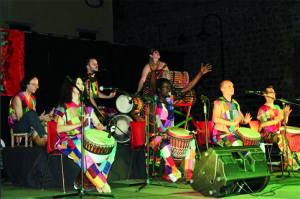
After a year, they are already changing, after three, they are different people. The fact of moving with such presence – because you must be present in the rhythm – helps women in the acceptance of themselves, and enhances the femininity. The woman begins to heal more, dress better, have a look more open, eyes brighter, the more upright posture. In short, she becomes aware of her possibilities: some change job, even some fellow. «To tell the therapeutic effects of African Dance is Barbara Mousy, founder of the school Afrodanza in Rome, teacher of African Dance, and dancer with various groups.
«The African Dance took me right away, because it is pure energy. I vent dancing. It’s something that starts from the beating of the heart, and I let myself go completely. It is a dance that comes from primordial sounds, the percussions, which are the basis of all modern music», adds Laura Dinon, of the association “Ponti Sonori” in Padova, which organizes dance classes and percussion, and from which it was born the group “Djolibè Djembè Family”.
«I love African Dance because I find it the perfect tool granting of a single frequency my body, my mind and my spirit», says Paola, who has been dancing for six years, attending internships throughout Italy.
And then, off your shoes, take contact with the earth, back to nature and let yourself go to the music, played mainly by percussion (djembé), in an almost symbiotic relationship between dancer and percussionist. Although it is true that who plays, gives the rhythm, it is also true that he chooses such rhythm, based on the energy that he perceives from the dancer. It is a real dialogue. These sounds are from Francophone Africa, where punctuate everyday life: birth and death, marriage and the stages of life, the joy and the pain, virility and the sweetness, good times and bad times. It dances when you wake up, you can dance in the evening. It affects the earth with the plow, spreading the seeds and harvest, it takes water from the well and then we cook all this becomes dance step. Even the movements of the animals: the pride of the lion, the elegance of the gazelle, the gracefulness of the birds, but also the awkwardness of the hen. In Africa it is a more than a dance, we can talk about performance, which includes dance, music, but also singing and, often, the narrative, the tradition of griots, the african storytellers. A visual narrative and sound, which becomes valuable tool of collective memory in a country where culture and traditions are handed down orally.
In Europe, the African Dance arrives in the 70s, with artists who try to combine it with western tastes. Today it speaks an universal language Among the most practiced rhythms are the doudoumba, which is the dance of the strong men, enhances stamina and skill; the koukou, with they celebrate the harvest; the mandjiani, which is the dance of the circumcision; the konkoba, which is the dance of the farmers, and so on.
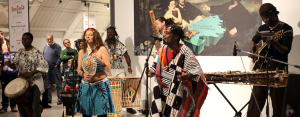
In Africa everyone dances, from child hears that already in the craddle, while his mother sings a variety of stunning bedtime lullabies. They dance but also the ederly, men and women, rich and poor. No matter who you are, how old you are, what you do or how you are. «I discovered that my curves were a bonus for this dance and I made peace with my body«, says Mousy. This peace with one’s body is a good thing in a society that forces you to impossible diets and exhausting physical exercises. But also the African Dance is no joke; movements are complex, each step must be earned “by the sweat”, as Lydia Grant in the hit series of the ’80s, “Fame”. But when you finally can hear the roots in the ground and, at the same time, to explore the upward push, the relationship between the various parts of the body is refined, and it is then that they develop fluency, accuracy and power. You can dance everywhere: in the gym, in the beach digging in the sand, on a meadow, with grass that caresses the sole of your foots. You can learn from an European or an African teacher (in Italy there are Aminata Touré, Only Diedhiou, Ismaila Kante, and many others). Different ways of teaching, but both valid. The first will dance in a more pedagogical and systematic, with the African teacher, you learn by imitation; when you do not understand a step, the teacher can repeat a hundred times, but he does ever details verbally, so a little “you africanizzi”.
«When I dance, I feel first of all myself – says Barbara Mousy -. I feel in the “here and now”, a molecule of energy, rather than a person who is representing something. African Dance helps you to dowload. Anger, tension, worries go away; while trying to stay in rhythm, you open up and throw out the negative you are holding. After I danced, I feel the adrenaline highest, endorphins brush the rose colour everything before could be gray».
© 2015 Romina Gobbo
published on Dance Sport International Magazine – July 2015
 Script and Click
Lascia un commento